Product lens · Career · 2026
My #@!%-ing job search in 2026. A bot applies, a bot rejects
Three months, 350+ applications and three interviews. I built myself an AI agent that finds vacancies and prepares applications, and on the other side another bot was waiting for me. Here’s where this funnel breaks, seen through a product manager’s eyes.
Natali Borisova · November 11, 2026 · 9 min read
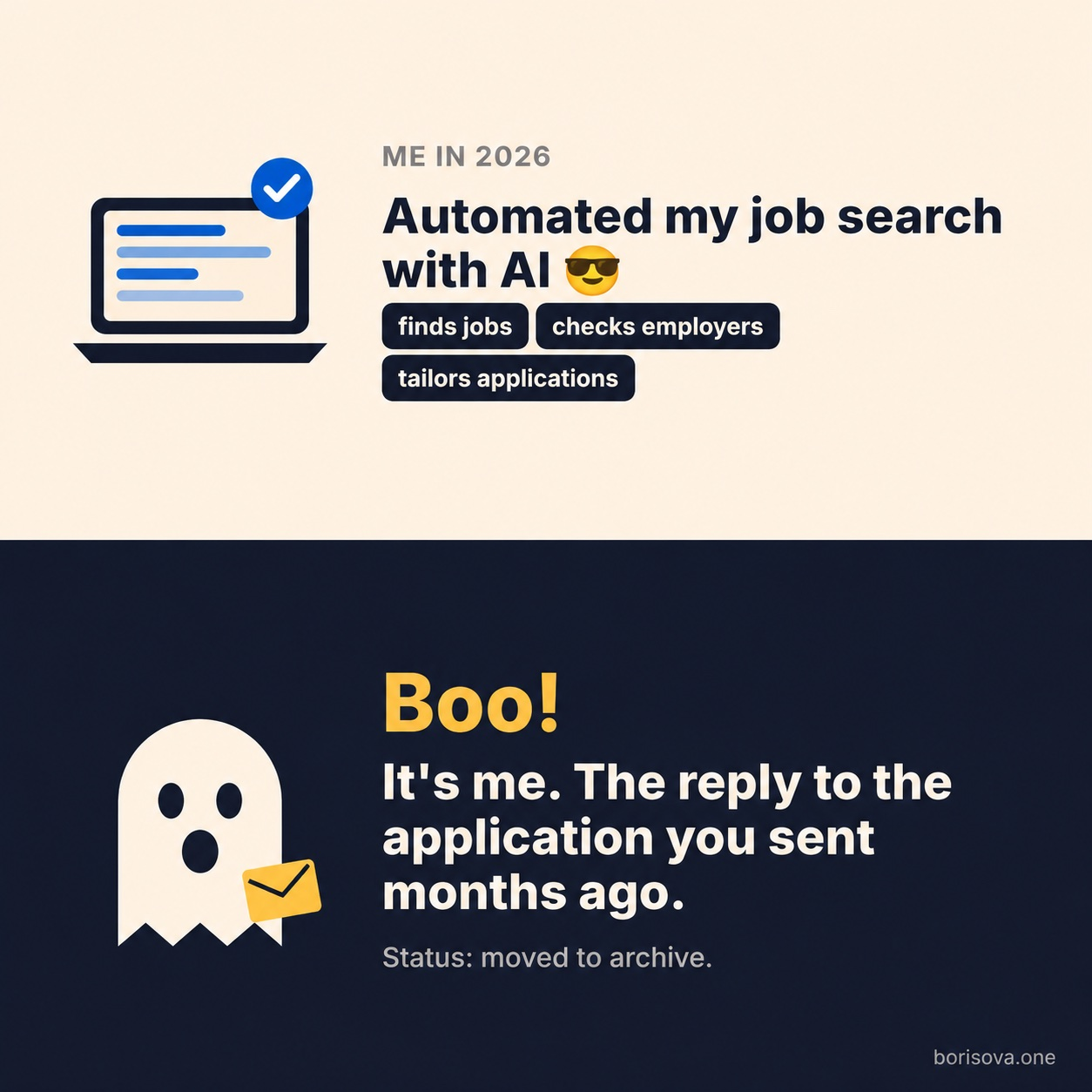
I spent 16 years in sales and grew to regional director, then moved into marketing, digital, EdTech and AI products. All of that is easy to show in a real conversation. Getting to that conversation is the hard part. So I did what any product person would do: I mapped my job search as a funnel and started looking for the place where it loses its user.
Section 1
My application pipeline
I had no wish to click a hundred buttons a day, so I used Claude Code to build a workflow that runs every morning without me. The agent collects fresh vacancies from HeadHunter (the biggest job board in Russia), Habr Career, Telegram channels and LinkedIn, removes duplicates and drops everything that doesn’t match my criteria.
The most useful part comes next. The agent checks every employer: its rating, employee reviews and any red flags I’d rather notice before I apply. Good matches go into a tracker in Google Sheets, where the agent picks the right version of my resume and drafts a cover letter for that specific role. I send every application myself, and only after I’ve read it.
My side · automated
Company side · black box
For the first time, the top of my funnel is predictable, and that feels great. Still, a well-prepared application is no guarantee that a human will ever read it.
Section 2
350 applications, 5 invitations, 3 interviews
Over three months, roughly 13 weeks, I sent more than 350 applications. Five of them turned into real invitations to keep talking, and only three of those became interviews. That’s an application-to-interview conversion rate below 1%. Any product team with a funnel like this would already be on an emergency call.
13
weeks of searching
350+
applications
5
invitations
3
interviews
The most interesting part is where those three interviews came from. One came through LinkedIn, one from a Telegram job channel and one from a referral. HeadHunter, the platform with by far the most vacancies, brought zero.
1
1
Telegram channel
1
referral
0
HeadHunter
HeadHunter gave me a whole genre of absurdity. An application gets the status Viewed, then the vacancy moves to the archive, and nothing else ever happens. Sometimes it goes the other way: a rejection arrives months later, when the vacancy has long been archived and I no longer remember applying. It’s a letter from the past telling me I didn’t get a job that no longer exists.
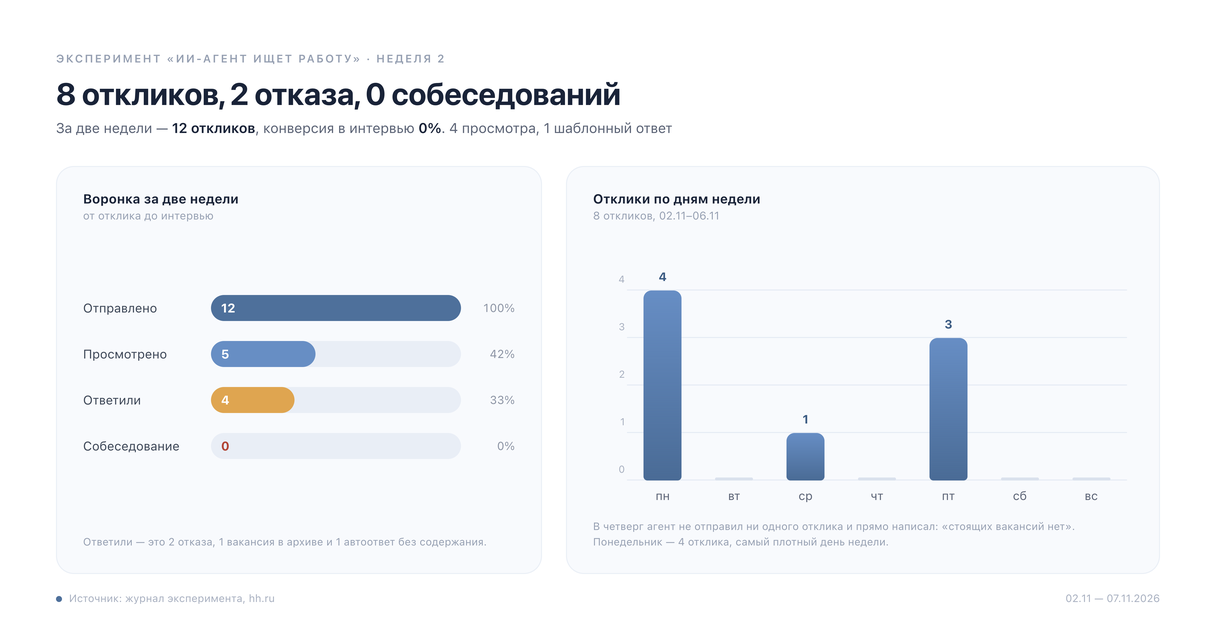
A very similar story appears in a job-search diary on Habr, a Russian tech community: 12 applications in two weeks, two rejections, zero interviews, and one vacancy archived together with the application. So this funnel is clearly not just my bad luck. The numbers back up the feeling too: in March 2026 Fortune reported that candidate ghosting by employers had hit a three-year high.
Section 3
This is where the product manager in me wakes up
If I read my numbers as product analytics, the conclusion is uncomfortable. The highest-volume channel produced zero interviews, and all three came from channels where it’s easier to reach a real person: LinkedIn, a Telegram channel and a referral from someone I know. Three interviews are too few for serious statistics, but the signal is loud: the more automated the channel, the lower its conversion into a conversation.
Another product pain hides in the statuses. In a good product, every status leads to a next step. A Viewed status with no next step only adds anxiety, and a rejection for a vacancy archived a month ago shows that the statuses in the system live separate lives.
Picture an online store that turns most shoppers away at the door and celebrates how fast it handles the queue. No product manager would call that a success, because the store has no idea how much revenue it just lost. Today’s hiring funnel looks a lot like that store.
For a candidate, a job search has one real outcome: a conversation with a person who can judge their experience. For a company, the outcome is a strong person on the team. Screening speed is useful, yet it’s only an intermediate metric. When a team optimizes it in isolation from the goal, it walks straight into a classic product trap.
The filter made the decision faster. It didn’t necessarily make it right.
When a system treats matching keywords as matching skills, a strong candidate gets screened out at step one. The company never sees that loss, because in its reports it looks like one more processed resume. In product analytics we call this a blind spot, and it’s the most expensive kind, because it never shows up on a dashboard.
At AI Empire we went through more than 168 survey responses and split our audience into 5 segments using Jobs To Be Done. We needed to understand why people leave before we touched the funnel. Over 4.5 months the project gained 242 new paid subscriptions with zero ad budget. Hiring almost never runs this kind of analysis: a candidate drops out, and nobody ever learns why.
Section 4
Referrals: networking or the old boys’ club?
Advice to ask someone for a referral comes from every direction right now. In my numbers, a single referral produced as many interviews as LinkedIn, and more than all my HeadHunter applications combined. It’s funny and sad at the same time.
Referrals have always been a normal part of hiring, and there’s nothing wrong with that. Things change when cold applications almost stop leading to conversations. At that point the referral program becomes the only door into the building, and the market slips back to the old rule where what matters is who put in a word for you.
From a product point of view, a referral should help a candidate get into the review queue. After that, the skills check should be the same for everyone. Otherwise a company hires the people who are easiest to notice and misses the ones who would do the job better.
Section 5
What I would test in hiring
Dropping automation makes no sense: nobody is going to read thousands of identical resumes by hand, and that’s fine. I would start with a small hiring MVP and four hypotheses, each of which can be tested on a single role.
Hypothesis 01
Show that the vacancy is alive
If candidates can see whether a position is approved and when applications close, they’ll stop wasting time on ghost jobs. Rejections should go out on the day the vacancy closes, so nobody gets letters from the past anymore.
Metric: Share of vacancies archived without a single interview.
Hypothesis 02
Explain the filter
If criteria are split into must-haves and nice-to-haves, and rejections come with a one-line reason, candidates will apply more precisely and recruiters will get fewer random resumes.
Metric: Share of applications that pass initial screening.
Hypothesis 03
Let candidates show their work
A short task with clear criteria will surface strong people a keyword filter would have rejected. This matters most for career switchers who describe their experience in different words.
Metric: How many finalists came through the task.
Hypothesis 04
Audit false rejections
If someone manually reviews a small sample of auto-rejected resumes once a week, they will find candidates worth a conversation. It’s the cheapest way to see the filter’s blind spot.
Metric: Share of false rejections in the sample.
I would launch this as a pilot on one role with a small team, comparing the usual process with a version where the filter is explainable. Four things are worth tracking: time to the first meaningful reply, the step where the company loses candidates, how new hires perform after three months, and how many strong people came in without a referral.
I’ve tested this approach many times on products. During my internship at a federal retail chain, our team of 16 built the first product loop of 8 stages. The main lesson was simple: a loop only works when every stage gets feedback. In hiring, feedback ends right after the Apply button.
Section 6
While the market thinks, I do my part
I’m not waiting for hiring to get friendlier, and I’m using this time well. I built a platform for an expert with Cursor in 1.5 months, and now I’m going deeper into AI agents and automation, the same tools my job search runs on.
The results I deliver haven’t gone anywhere. At Signatura we grew revenue from zero to over 1 million rubles a month, and at AI Empire payments grew by 48.9% and paid conversion by 21.9% in September compared to August. I’m happy to show how it was done in any interview. All I need is a chance to get there.
Four takeaways for anyone building hiring
- Measure conversion by channel. A channel that brings hundreds of applications and zero conversations creates noise for both sides.
- Screening speed is an intermediate metric. The real measures of hiring are the quality of new hires and the number of strong candidates lost along the way.
- Candidates are users too. Silence is the worst possible user experience, and even an automated rejection with a clear reason beats months of nothing.
- When AI works on both sides, the winner is whoever puts a human at the right point in the funnel. Every interview I got came from a channel where it’s easier to reach a real person.
In my next article I’ll look at where AI truly makes a specialist stronger and where it only creates an illusion of competence.